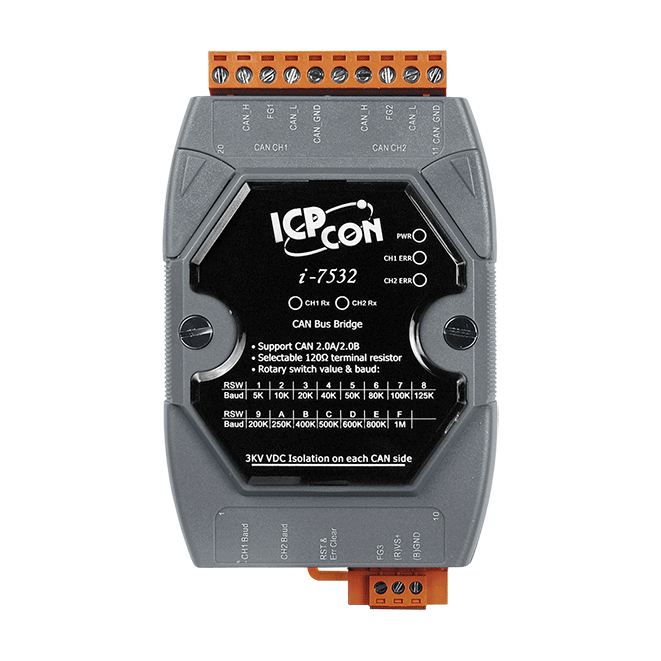
2 CAN channels, 2 x 2-wire CAN interfaces (plus power and ground terminals)
CAN Bus conversion, bridging two CAN networks, industrial automation, automotive, monitoring distributed CAN nodes
2 x CAN (CAN CH1, CAN CH2) terminal block connections
-25C to +75C
123 mm x 72 mm x 35 mm (approximately)
Not Supported; Device functions as a bridge/gateway, not as an IP router
3KVDC isolation per CAN side, selectable 120 terminal resistor, rotary switch for value & baud selection
Up to 1000 meters (dependent on baud rate and cable type)
Not applicable (Wired device)
Industrial Protocol Converter (CAN Bridge)
Supports baud rates from 5 kbps to 1 Mbps
Protocol Converter (CAN Bus Bridge)
3-pin removable terminal block
PWR, CH1 ERR, CH2 ERR, CH1 Rx, CH2 Rx
3KV DC (CAN CH1 to CH2)
Industrial grade plastic, flame retardant
CAN 2.0A and CAN 2.0B compatible
Surge and ESD protection on CAN lines
Rotary switch for baud rate and CAN value selection
Supported
Selectable 120 built-in via DIP switch
Product Description
A protocol converter is a hardware or software device that translates data between incompatible communication protocols, enabling seamless interoperability between different systems, devices, or networks. It acts as a bridge, allowing machines from different manufacturers or generations (e.g., legacy to modern) to exchange information.
Key Characteristics and Functions
Protocol Translation: Converts, for example, Modbus RTU to Modbus TCP, or serial (RS-232/485) to Ethernet.
Master-Slave Architecture: Often functions as an internal master collecting data from slave devices and mapping it to a database accessible by an external master.
Interoperability: Bridges various technologies in Industrial Automation, Building Automation, SCADA systems, and Internet of Things (IoT) platforms.
Medium Conversion: Frequently converts data transmission media, such as changing copper cable signals to fiber optic
Robust CAN Protocol Support
This device acts as a bridge between two independent CAN networks, supporting both CAN 2.0A and 2.0B standards. Its dual-channel design and selectable baud rates make it highly versatile for industrial and automotive applications, ensuring reliable data transmission across complex systems.
Industrial Grade Design & Safety
Featuring 3KV DC isolation between its CAN channels, the protocol converter ensures safe and stable operation in harsh environments. Surge and ESD protections are built-in, and the housing is made of flame-retardant industrial-grade plastic. It mounts securely on DIN rails, fitting effortlessly into control panels and enclosures.
Flexible Configuration & Monitoring
With rotary switches for baud rate and channel value selection, configuration is simple and tool-free. LEDs provide clear indication of power status, errors, and data activity on both CAN channels, aiding troubleshooting and system diagnostics.
FAQ's of protocol converter:
Q: How do I configure the CAN baud rate and channel value on the protocol converter?
A: You can set the CAN baud rate and channel value by using the rotary switches on the device. This allows efficient and precise adjustments without the need for software tools.
Q: What level of electrical isolation does this protocol converter provide between the CAN channels?
A: The converter offers 3KV DC isolation between CAN CH1 and CAN CH2, effectively safeguarding against electrical surges and minimizing signal interference.
Q: When should I activate the built-in terminal resistor?
A: Activate the built-in 120-ohm terminal resistor using the DIP switch if your converter is placed at the end of a CAN bus segment. This helps prevent signal reflections and ensures data integrity.
Q: Where can I mount this protocol converter in my system?
A: The device is designed for easy DIN rail mounting, making it suitable for installation in industrial control panels, automation cabinets, or automotive test benches.
Q: What are the main benefits of using this protocol converter in CAN networks?
A: This converter enables seamless bridging between different CAN segments, offers high electrical protection, and simplifies setup and monitoring, thus enhancing system reliability and reducing maintenance time.
Q: How far can the CAN bus cable be extended using this converter?
A: Cable length can reach up to 1000 meters, depending on selected baud rate and cable type, enabling flexible deployment across large industrial facilities.
Q: Is there IP routing functionality in this device?
A: No, this device acts strictly as a CAN bridge or gateway and does not support IP routing. It is engineered for direct CAN network connections via terminal blocks.
Tell us about your requirement
Price:
Quantity
Select Unit
50
100
200
250
500
1000+
Additional detail
Mobile number
Email
Name
Comapny Name
Phone Number
Email Id
City / State
Confirm Your Requirement
Verification Code
Did not receive yet?
Resend OTP
You’re Done!
We have received your requirements and will reply shortly with the best price.
Products You May Like
Other Products in 'Internet Service Provider' category





 Send Inquiry